
Who's in charge here?
The self-defeating dilemma of protest without leadership

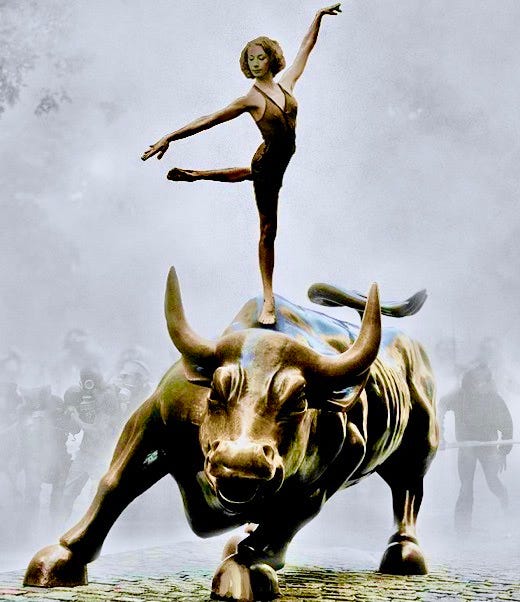
(The most lasting impression of the “Occupy Wall Street” protest might well have been Roberto Ciccarelli’s image of a ballerina atop the Wall Street bull, published in Il Manifesto.)
Who’s in charge here?
by David Benjamin
“Power concedes nothing without a demand. It never did and it never will.” — Frederick Douglass
MADISON, Wis.—To fill my class schedule in my last college semester, I signed up, reluctantly, for a course entitled “Leadership Lore.” My professor, whose specialty was classics, steered his students toward ancient conquerors like Cyrus the Younger and Alexander the Great. But his modern example was Don Corleone in Mario Puzo’s novel, The Godfather. I was forced to read the book, which—as you know—is bloated, digressive and melodramatic. It merits consideration as the epitome of bad novels turned into a good movies.
I think my prof’s eccentric choice of Don Corleone was meant to illustrate leadership that is powerfully charismatic but also pernicious. But I wondered why not select, instead of a fictional mobster, a real one, like Al Capone, or a modern politician who created a populist cult while steeped in corruption, like James Michael Curley in Boston or Huey Long, the legendary “Kingfish” of Louisiana.
For a more cogent and contemporary parallel leadership model, he might have focused on the civil rights movement, which was still happening. After Reconstruction ended in 1877, black Americans’ struggle for their rights went virtually leaderless. The foremost black statesmen of that era, Frederick Douglass and W.E.B. Du Bois, were obscurities in a white supremacist America of Jim Crow laws, hiring discrimination, segregated schools, redlining and a Congress that refused to pass an anti-lynching until 57 years after the murder of Emmitt Till.
Civil rights did not emerge from the shadows ’til it had visible, dynamic leaders, particularly the Rev. Martin Luther King, Jr. At midcentury, seemingly overnight, Dr. King rose to become the vanguard of eloquent and relentlessly outspoken leaders who forced racial equality to the forefront of America’s political discourse. Before Dr. King, there were obscure and cerebral leaders in the black community. I remember Nobel Peace Prize laureate Ralph Bunche and, of course, Thurgood Marshall, who argued Brown v. Board of Education before the Supreme Court. But guys like these didn’t command as much air time as the upstart Georgia preacher who led sit-ins, marched the streets with strikers, defied the Klan, went to jail for his beliefs, and stood in front of Abe Lincoln shouting, “I have a dream!”
Led by Dr. King, America suddenly had a chorus of black voices who were household names. They seemed to appear everywhere, representing different factions within the civil rights movement. King’s prominence made possible the notoriety of Malcolm X and Stokely Carmichael, Julian Bond. Andrew Young, John Lewis and Jesse Jackson, as well as firebrands, Panthers and convicts—Angela Davis, Bobby Seale, Huey Newton, Eldridge Cleaver.
Like Churchill and Lincoln, these were leaders sufficiently articulate to clearly expose issues that had to be confronted, but also thoughtful enough to explain methods and solutions. They demanded change and hammered their program over and over in writing and on TV. And they risked their lives.
We didn’t study any of these folks in my Leadership Lore course, which I passed and promptly forgot … until, while I was living in New York, the “Occupy Wall Street” team invaded Zuccotti Park. There, the occupants styled themselves as a pure democracy, without leaders, without even a voice. Several times, pressed by reporters, an occupant dared to step up and respond. But this was a club with a code. The popinjay who broke silence was stifled by peers or sent packing from the park. The Wall Street Occupants, as far as I could tell, professed a sort of telepathic faith that the world would implicitly understand—through its symbolism—what’s wrong, why they were doing this, and what must be done to set things right.
For a while I was a fan of this guerrillas theater camp-out. After all, I’m from the Sixties. I was tempted to visit Zuccotti Park, take photos and intimate my solidarity. But by the time the NYPD moved in and sent the occupants back home to Westchester, while a sanitation crew filled a hundred trucks with pup tents, soiled blankets and symbolism, I muttered good riddance. The evicted purists had achieved little beyond adding the word “occupy” to the limited vocabulary of the disgruntled. They hadn’t uttered the word, “dream,” nor any word that would be remembered.
This annoyance I felt about Occupy Wall Street—call it protest fatigue—came back around in Madison last month when four police officers ganged up on Corey Ruiz, a petty crook with lifelong mental health issues, and shot him three times. This happened on the corner of Baldwin and Williamson Streets.
Suddenly. an “Occupy Willy Street” encampment sprang up. Roadblocks were erected. Tents were pitched. An unsightly memorial obelisk rose from the street. Flowers piled up beneath. For weeks, an army of the “unhoused” halted all traffic and shut down commerce—except to provision the impecunious occupants.
I pause to note that Willy Street is a Madison treasure, one of several urban corridors—along with State and Monroe Streets—where dozens of small businesses intermingle with apartments and houses, where sidewalks feature a constant flow of shoppers, students, dog walkers, restaurant patrons and neighbors who often pause to say hello. It’s a street where folks recognize one another.
As for the death of Corey Ruiz, well, everything was obvious. There’s video. Everyone in town knew, implicitly and immediately what the trouble was. There was reason for outrage, for the community to demand accountability.
On the other hand, few people had any idea why this blatant travesty of police overkill required a thousand or so people—none with any relation to the cops or the victim involved—to sit around campfires, sleep on the pavement, go without baths and threaten the livelihoods of shopkeepers, bartenders, waiters and coffee-shop baristas.
Of course, there was nobody to explain. Madison mayor Satya Rhodes-Conway summed up her dilemma: “There was not one leader, one group, one coalition that represented the people occupying the intersection.”
Rhodes-Conway, of course, will have some explaining to do, although not ’til the fate of Corey Ruiz and his blue-clad myrmidons worms its equivocal way through the squeamish courts. Then, at last, there be a coherent cause for protest, because, then, the immutable Golden Rule of Police Violence will apply:
The cops always get away with it.
The police who killed Corey Ruiz will tell the judge and jury that the “perp” brandished a knife—which he did, but hardly well enough to stab even one cop, much less four of them. They’ll say he resisted—which he also did, which seems like a normal reaction to being kicked, beaten, tased and shot at. Each cop, at last, will invoke the six magic words of absolution: “I was afraid for my life.”
Inevitably, “Occupy Willy Street” ended quietly, with a police sweep, a few desultory arrests and an epic cleanup. Corey Ruiz’s champions of justice dispersed with little to say after having had little to say. Over two weeks of recreational chaos. no coherent voice had emerged among the occupants to articulate a program aimed at rooting out the persistence of police violence. Nothing was done for Ruiz’s family—although I hope they got a little money out of it.
Unlike my flirtation with Occupy Wall Street, I wasn’t inclined to visit. I felt scant sympathy for a leaderless and pointless rabble who, I knew, would break up and scurry off as soon as they wore out their welcome. They were a tale untold—but idiotic—full of mute fury, signifying nothing.
Corey deserves better.
* * *
PERSONAL STUFF
Junko returned from an autonomous technology symposium in San Diego, in time to spend a weekend in recovery with Benj, and generate dispatches on the vast gaps in road safety that the promoters of self-driving “robotaxis” have yet to solve. You can read her latest at

.Benj, meanwhile, continued research on his work in progress, a novel called Shark-Fishing in the Seine, which will be sequel to his 2019 murder mystery, set in Paris, Skulduggery in the Latin Quarter. Benj’s research centers on the story’s “maguffin,” a scandal involving a spectacular diamond necklace created for—but never worn by—Marie Antoinette in the tumultuous years before her execution. All this reading has turned Benj, somewhat reluctantly, into an “expert” on the eighteenth-century jewelry market.
Our social highlight was a Wednesday Steering Committee meeting hosted graciously by our friend Leslie in the heart of the Arboretum, with Gaylord, Mark & Liz, Patty & Oren. Thanks, Leslie!
* * *
(Learn about David Benjamin’s books—including Skulduggery in the Latin Quarter and his other “Paris books,” Three’s a Crowd, Bistro Nights and An Apasrtment in Paris —on his Last Kid Books website. You can also watch Benjamin’s “GabTalks” interviews, access all his titles and scroll through an archive of Weekly Screeds, all at: https://lastkidbooks.com/